
Retro Sci-fi Name Generator
Name It Like It's 1954
Call a weapon a "blaster," and it sounds like something a child invented. Call it the Neutron-Vaporizer Mark IV, and suddenly there's a whole manufacturing history implied. A government contract. A test range somewhere in Area 51 and scientists who probably should have asked more questions.
The names in classic science fiction were not random. They followed a logic — compressed, scientific-sounding, just plausible enough to suspend disbelief. That logic is worth understanding, because it turns out it's also a lot of fun to reverse-engineer.
Greek Letters and Doom: A Brief Taxonomy
The naming conventions of atomic-age sci-fi drew from a specific toolkit. Once you see it, you can't unsee it.
The Greek Prefix. Alpha, Beta, Zeta, Omega — slap one of these on anything, and it immediately sounds like it belongs to a series. Omega implied finality. Zeta implied you were already six models in. Both implied danger.
The Pseudo-Scientific Noun. Atomizer. Irradiator. Disintegrator. Vaporizer. These were real words (mostly) stripped of any industrial specificity and repurposed as proper nouns. The effect was the feeling of plausible technology that you did not fully understand, which is exactly the feeling the genre was after.
The Model Designation. Mark II. Model B. Class Seven. These implied manufacturing. Testing. Previous versions that presumably worked less well. There is something deeply reassuring about a weapon labeled "Model B." It means they fixed whatever happened with Model A.
The Exotic Fuel Source. Uranium cartridges. Refined plasma. Solar-charged cells. Atomic-age sci-fi was obsessed with power sources, which makes sense given that the atomic bomb had just redefined what "power" meant. The fuel was rarely explained. It was simply named.
Put these elements together, and you get names that feel inevitable — like they couldn't have been called anything else.
What the Tool Does
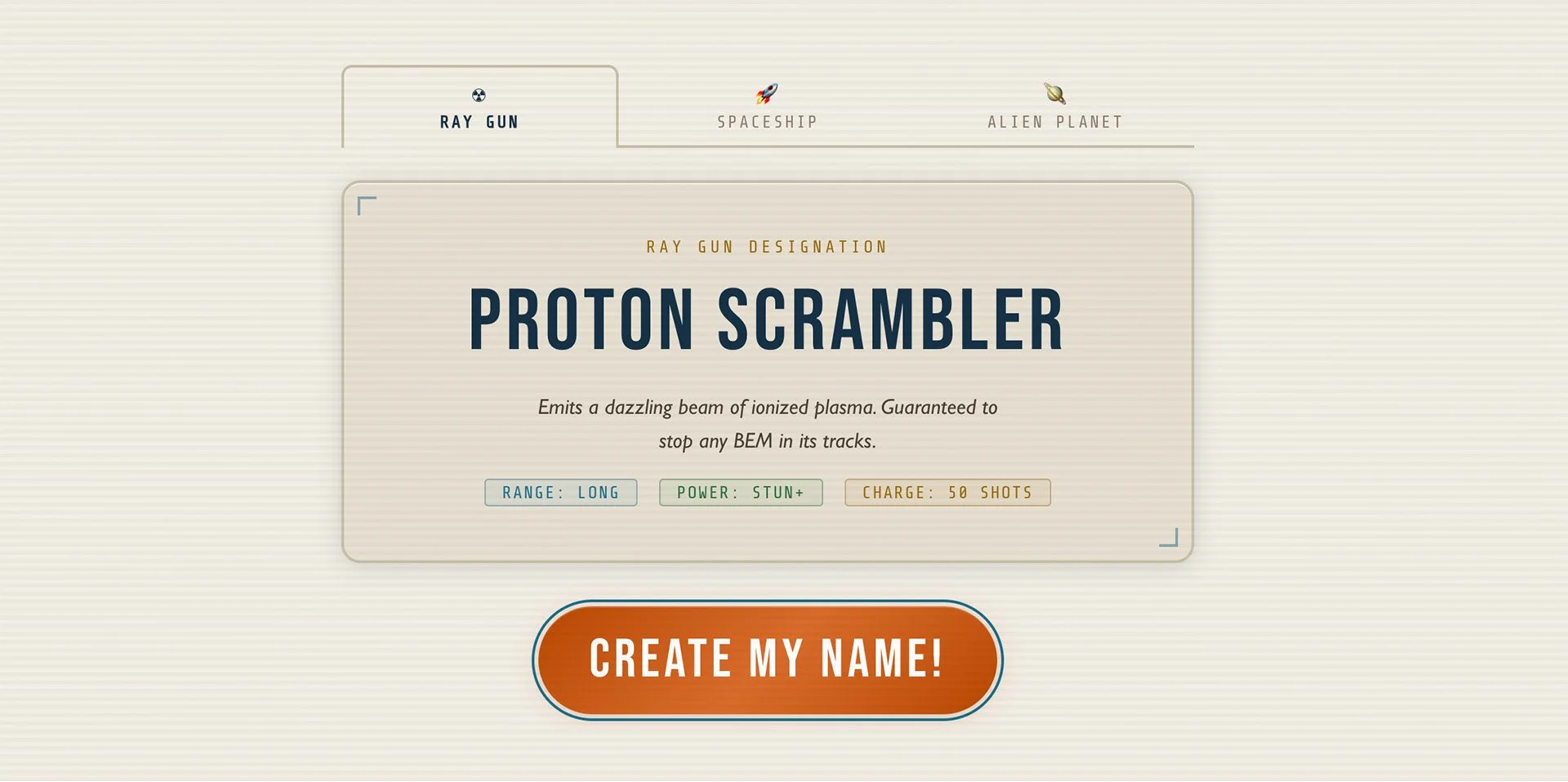
The Retro Sci-Fi Name Generator at lab.liquidtwist.com applies exactly this logic across three categories.
Ray Guns get full designations: a prefix, a function, a model, or mark number. Each one comes with a brief flavor description that reads like it was excerpted from an atomic-age equipment manual. The Zeta-Irradiator Plus, for example, is described as "atomic-age engineering at its finest. Approved by the Space Patrol (mostly)." The "(mostly)" is doing a lot of work there. The Magno-Atomizer Model B runs on "refined uranium cartridges. Spare cartridges sold separately." Which raises several questions, none of which the manual answers.
Spaceships get class names and designations that suggest they belong to a larger fleet — the kind of fleet where every ship has a plaque in the mess hall and a casualty count that someone has stopped updating. These are not sleek interstellar yachts. These are working vessels. You can tell.
Alien Planets get names that sound phonetically alien without being completely unpronounceable. The flavor text usually includes a brief note about atmospheric conditions, likely fauna, or the number of Earth expeditions that returned. That last number is frequently low.
The Retro Sci-Fi Name Generator is live at lab.liquidtwist.com.